
How to Unlock 1000 HP from Toyota’s Legendary 2JZ-GTE
The 2JZ-GTE is the most proven path to 1,000 horsepower in the JDM world. Built by Toyota with a closed-deck iron block, factory-forged crankshaft, and massive oiling capacity, it was not just engineered to produce 276hp in JDM trim — it was engineered to survive whatever boost you throw at it. Four-digit power is no longer exceptional for the 2JZ platform. With the right forged internals, a big single turbo, and a properly dialed standalone tune, 1,000HP is achievable, streetable, and sustainable.
This guide covers the complete build path — internals, turbo selection, fuel system, engine management, and supporting mods — for builders chasing 1,000 horsepower from the Toyota 2JZ-GTE. For a full breakdown across all power levels from 400–1,000HP, see our Complete 2JZ-GTE Build Guide covering every power tier. Shop the full 2JZ parts catalog at J-Spec Garage.
Why the 2JZ-GTE Is Built for 1,000HP
When Toyota engineered the 2JZ-GTE in the early 1990s, they built a platform that would outlive its era by decades. The closed-deck cast-iron block provides structural rigidity that few production engines can match. Inside, a factory-forged steel crankshaft with thick main journals handles high-RPM loads that would destroy lesser platforms.
Cast-Iron Block and Forged Crank
The closed-deck architecture limits block flex under boost — a critical advantage at 30+ PSI. The factory forged crank, counterweighted for high-RPM stability and running on large main bearing journals, gives the 2JZ-GTE a bottom-end foundation routinely compared to billet-level strength straight from the factory.
How the 2JZ Compares to LS, RB, and K-Series at High Power
Every major tuner platform has its ceiling. LS blocks often require sleeving above 700hp. RBs demand careful oiling and main cap attention. K-series engines excel naturally aspirated but struggle past 500–600hp under sustained high boost without extensive work. The 2JZ takes boost naturally — factory-designed around a sequential twin-turbo system, it scales with more pressure in a way few production engines do.
What Breaks First on a Stock 2JZ at 1,000HP
Stock pistons begin failing under sustained boost in the mid-20s PSI range — ring lands crack, pistons deform under repeated thermal cycling. Stock rod bolts stretch under the cylinder pressure of a high-boost build. The block itself survives; the rotating assembly is what needs upgrading. Chasing four-digit power means forged internals are not optional.
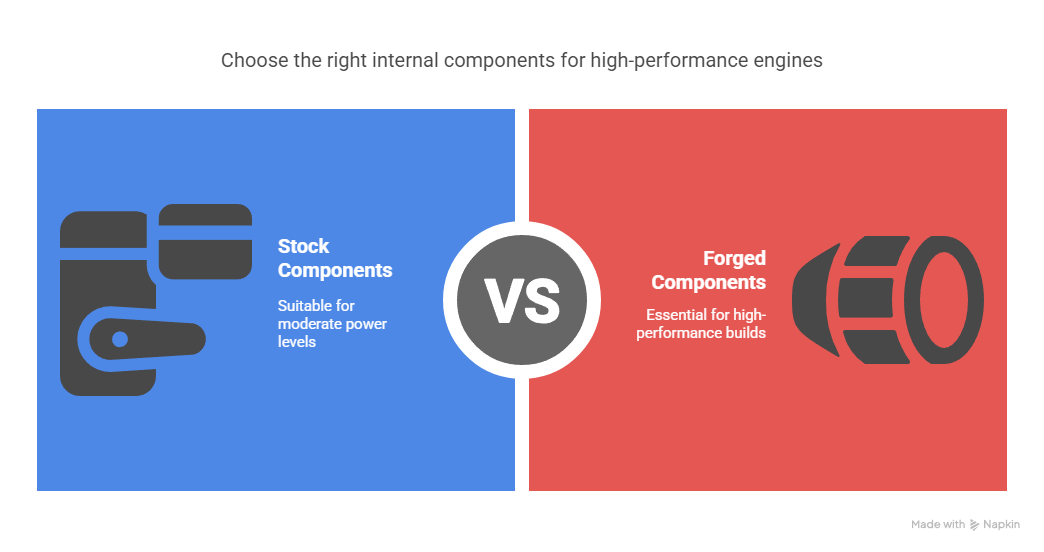
Forged Internals for a 1,000HP 2JZ-GTE Build
The rotating assembly is the foundation of any high-power build. To reliably support 1,000HP, every component from pistons to main studs needs to be purpose-selected for sustained high-boost operation.
Pistons and Connecting Rods
Most 1,000HP 2JZ builds spec 8.0:1–8.5:1 compression forged pistons paired with 4340 steel H-beam connecting rods and ARP rod bolts. Lower compression buys detonation resistance when running 25–30 PSI on pump fuel or race gas. Brian Crower makes forged pistons, ProH625+ connecting rods, and ProH2K rods with ARP2000 fasteners purpose-built for the 2JZ-GTE — all stocked at J-Spec Garage.

Bearings, Thrust Washers and ARP Main Studs
ACL Race bearings are the consensus choice for high-power 2JZ builds — tighter tolerances and better oil clearance under extreme load. Reinforced thrust washers handle the lateral forces of aggressive clutch use and drag launches. ARP main studs and head studs are required above 25 PSI to prevent cap walk and head lift — two catastrophic failure modes at this power level.
Assembly Standards at 1,000HP
Power is built in the details. Every bearing must be plastigaged. Clearances checked and corrected to spec. Main studs torqued in a three-step sequence. Assembly lube — not engine oil — on all rotating surfaces. A professional machine shop and experienced engine builder are not optional at 1,000HP. Skip either and the build will not live there reliably.
Best Single Turbo Setup for 1,000HP on a 2JZ-GTE
The factory sequential twin-turbo system was advanced for its era but is a hard cap for four-digit power. Flow restriction, heat soak, and the inherent complexity of a sequential setup make it unsuitable for 1,000HP. Every serious 1,000HP 2JZ build runs a large single turbo.
Why the Factory Sequential Twins Cannot Make 1,000HP
Sequential twin-turbo systems create flow restrictions and introduce tuning complexity at high power levels. The small factory turbos cannot flow enough air for 1,000HP, and the transition between primary and secondary boost becomes unpredictable under extreme load. A single large-frame turbo eliminates the complexity and dramatically raises the power ceiling.
Best Turbos for a 1,000HP 2JZ Build
Proven single-turbo options for 1,000HP on the 2JZ-GTE:
- Garrett G42-1200C — fast spool for its frame size, genuine 1,000HP+ headroom, and an excellent all-around option for street and track builds
- Precision 6870 — high efficiency across a wide RPM range, strong boost control, popular for drag-focused 1,000HP builds
- Garrett T04Z — proven, widely-tuned, a solid budget entry into four-digit power with the right manifold and setup
Manifold, Wastegate and Exhaust Sizing
A custom single-scroll or divided twin-scroll exhaust manifold is essential. Match it with a 45mm minimum external wastegate for precise boost control. Downpipe and exhaust should be 3 inches minimum — 3.5 inches for 800HP+ builds. Free-flowing exhaust reduces backpressure and keeps heat out of the engine bay. Shop Supra turbo manifolds and forced induction hardware at J-Spec Garage. J-Spec also stocks Precision Turbo PTE GEN2 wastegates in 39mm, 40mm, 46mm, and 56mm for EWG applications.
Intercooler for a 1,000HP 2JZ
Charge air temperatures rise fast under 25–30 PSI. A front-mount intercooler of 600x300mm or larger is the minimum for 1,000HP. Undersizing the intercooler is one of the most common mistakes on high-power builds — heat-soaked charge air destroys the tune and invites detonation at the worst possible moment.
Fuel System for a 1,000HP 2JZ-GTE
At four-digit power, fuel supply becomes a limiting factor as urgently as airflow. The stock system is completely inadequate, and even modest upgrades fall short under sustained wide-open throttle.
Injector Sizing for 1,000HP 2JZ
Depending on fuel type, you will need 1,050cc to 2,600cc injectors. Injector Dynamics offers the most precisely characterized injectors on the market — critical for stable tuning at the edge of capability on a high-power build. Run the ID1050X (set of 6) for builds in the 600–700HP range on E85; the 1340cc series (set of 6) for 700–900HP; and the 2600-XDS for builds pushing 1,000HP+.
Dual Fuel Pump Setup
One pump will not supply enough fuel at 1,000HP under sustained load. Dual high-flow in-tank pumps running in parallel — with proper relay wiring to prevent voltage drop — are the correct setup. J-Spec stocks the Walbro Universal 450lph high-pressure in-tank pump and Aeromotive 525lph in-tank pump. Many builds add a surge tank to maintain fuel pressure during sustained wide-open throttle pulls on track.
Fuel Rail, FPR and Lines
High-flow billet fuel rails, a boost-referenced fuel pressure regulator, and minimum -8AN braided fuel lines for both supply and return ensure fuel pressure stays stable at full boost and redline RPM. PHR makes Supra-specific hardware for the JZA80 — including the PHR Aluminum Race Radiator for the MK4 Supra and billet engine bay components. Browse the full PHR collection at J-Spec Garage.
Engine Management for a 1,000HP 2JZ-GTE
A standalone ECU is non-negotiable at this power level. Stock ECUs and piggybacks do not have the precision or safety features required for reliable 1,000HP operation.

Standalone ECU Options for 1,000HP 2JZ Builds
The most widely used standalone ECUs for 1,000HP 2JZ builds are the Haltech Elite 2500, AEM Infinity, Link G4X, and MoTeC M150 — all carry strong US tuner support for the 2JZ platform. J-Spec Garage stocks Haltech sensors, MAP sensors, boost solenoids, and CAN accessories to support these builds.
Required Sensors for a 1,000HP 2JZ
At minimum: wideband O2 for accurate AFR, 4-bar MAP sensor for proper boost resolution up to 43 PSI, and IAT sensor for timing compensation and knock protection. Additional ethanol content and EGT sensors improve tuning accuracy and safety margins at the edge. Haltech-compatible sensors are stocked at J-Spec Garage.
Ignition Upgrades for 1,000HP
Stock coils and ignitors fail under sustained high boost. Upgrade to R35 GT-R coils or IGN-1A smart coils. Run iridium spark plugs — NGK BKR8EIX — with correct gap for your boost level to prevent misfire and plug blowout under pressure. Weak ignition at high boost is a common cause of detonation events on otherwise well-built engines.
Supporting Mods for a 1,000HP 2JZ Build
Transmission Options
The factory V160 six-speed is iconic and strong but increasingly rare and expensive. Alternatives include the CD009 Nissan six-speed with adapter kit, and the T56 Magnum for domestic parts availability and torque capacity. Budget transmission work into the build from the start — ignoring driveline limits until something snaps is one of the most common mistakes at this power level.
Cooling System for 1,000HP
High horsepower generates high heat. Minimum cooling upgrades for a 1,000HP 2JZ: aluminum radiator with dual electric fans, external oil cooler with thermostat, and a catch can system to manage crankcase pressure at sustained high boost. An undersized cooling system is one of the most common reasons high-power builds become unreliable on the street.
Traction and Suspension
1,000HP is useless without grip. At minimum: 275+ drag radials, a quality LSD or aftermarket differential, coilovers with adjustable dampers, and reinforced control arm bushings to manage torque transfer under hard launches and during sustained high-power operation.
1,000HP 2JZ-GTE Build Cost and Timeline
Budget Breakdown
- Entry-level 1,000HP build (core components): $20,000–$25,000
- Premium parts, professional build: $30,000–$40,000+
- Costs vary based on machine work quality, brand selection, and whether labor is included
Timeline: Tear-Down to First Dyno Pull
3–6 months from engine tear-down to first power pull on a professional build — longer with custom fabrication or parts lead time. Budget for multiple dyno sessions; 1,000HP requires careful iteration on the tune to dial in safely and sustainably.
Common Mistakes to Avoid on a 1,000HP 2JZ Build
- Running stock ignitors or factory wiring with a high-output ignition system
- Underestimating the fuel system — a lean-out event at 1,000HP destroys even the best-built motors
- Choosing turbo size based on peak HP claims rather than spool characteristics and efficiency range for your power target
- Ignoring driveline limits — transmission, differential, and axles — until something fails under power
- Skimping on the tune; professional tuning is where the build comes alive and where reliability is actually established
1,000HP 2JZ-GTE Build FAQ
Can a stock 2JZ-GTE handle 1,000 horsepower?
Not reliably. While the stock 2JZ-GTE bottom end has been documented surviving up to 700–800HP on short pulls, reaching 1,000HP safely requires forged pistons, upgraded connecting rods, ARP rod bolts, a complete fuel system, and professional tuning. The cast-iron block and forged crank can stay — the pistons, stock rod bolts, and fuel system cannot.
What turbo is best for a 1,000HP 2JZ-GTE?
The most popular options for 1,000HP on the 2JZ-GTE are the Garrett G42-1200C, Precision 6870, and Garrett T04Z. These turbos offer the airflow capacity for four-digit horsepower while remaining manageable on a quality single-turbo manifold setup. Turbo selection should always follow power target and intended use — a drag-only build and a street-track car should not share the same turbo selection.
Do I need a standalone ECU for a 1,000HP 2JZ build?
Yes. A standalone ECU — Haltech Elite 2500, AEM Infinity, or equivalent — is required to manage fuel, ignition, and boost with the precision needed at 1,000HP. Factory ECUs and piggyback solutions do not have the resolution, safety features, or tunability required for reliable operation at this power level.
What fuel system do I need for a 1,000HP 2JZ-GTE?
You will need 1,050–2,600cc injectors depending on fuel type, dual high-flow fuel pumps, a billet fuel rail, a boost-referenced fuel pressure regulator, and high-flow -8AN braided fuel lines. Fuel tuning is your first line of defense against a lean-out event at peak power. Do not undersize this system.
How much does it cost to build a 1,000HP 2JZ-GTE?
A complete 1,000HP 2JZ-GTE build ranges from $20,000 to $40,000+ depending on part selection, machine work, and labor. Cutting corners at this power level is not a reliability risk — it is a safety risk. Build it properly the first time.
What is the difference between a 1,000HP 2JZ build and a 500HP build?
At 500HP, you are doing a single-turbo conversion, injector upgrade, fuel pump, and standalone ECU on a healthy stock bottom end. At 1,000HP, you add a full forged internal build, a significantly larger turbo and all the supporting components it requires, dual fuel pumps, and a much more demanding tune. The 1,000HP build requires higher-quality machine work, more precise assembly tolerances, and a tuner with direct experience at four-digit power levels on the 2JZ platform.
Ready to start sourcing parts? Browse the complete 2JZ parts catalog at J-Spec Garage — Brian Crower forged internals, Injector Dynamics fuel injectors, Aeromotive fuel pumps, and 12,000+ JDM performance parts with our price match guarantee. Building a Supra? Shop Toyota Supra turbo kits and manifolds here.