
FD RX7 vs FC RX7: 13B-REW vs 13B-T — Which Is Right for Your Build?
Share
Every rotary enthusiast eventually faces this question. The FC and FD RX-7 are both rear-wheel-drive, lightweight, rotary-powered sports cars from Mazda — and both have passionate builder communities. But they're different cars in almost every way that matters: engine architecture, chassis behavior, build cost, and long-term parts support.
This breakdown is for builders who need to make a decision, not just read about both. We'll cover the engines, the chassis, the real costs, and which platform makes sense depending on your goals.
J-Spec Garage is the only authorized US distributor of RaceOnly performance parts for both the FC and FD RX-7. That gives us direct daily experience with what builders are doing on both platforms.
FC RX-7 (1986–1992): The 13B-T Platform
The FC3S (also known as the Savanna RX-7 in Japan) ran from 1986 to 1992. It used the 13B-T — a twin-rotor Wankel engine displacing 1.3 liters (654cc per rotor × 2) with a single turbocharger producing 185–200 hp from the factory depending on market and year.
The FC's appeal is its simplicity relative to the FD. The 13B-T is an older engine with a less complex peripheral porting and induction system. It's easier to work on, simpler to tune on older aftermarket ECUs, and the parts availability — both OEM and aftermarket — is strong because the platform has been in the enthusiast community for 35+ years.
FC chassis notes: The FC is lighter than the FD — approximately 1,240 kg vs 1,300 kg in base trim. The suspension is double-wishbone all around on turbocharged models, with a rear multi-link setup that was progressive for its era. The chassis balance is excellent for its weight class, and the lighter unsprung mass from the smaller 15–16" wheels of the era contributes to nimble handling.
FD RX-7 (1992–2002): The 13B-REW Platform
The FD3S (third-generation RX-7) was Mazda's definitive statement on what a rotary sports car could be. The 13B-REW — the sequential twin-turbocharged version of the 13B — produced 255–280 hp from the factory and used a sophisticated sequential turbo system that delivered both low-end response and high-end power.
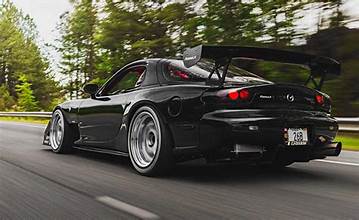
The FD's chassis is one of the finest platform designs from its era by any manufacturer. 50/50 weight distribution, push-rod rear suspension, and a body design that achieved exceptional aerodynamics without making it look like an engineering exercise. The FD is widely considered to be one of the best-handling factory cars ever produced for its power class.
FD engine complexity: The 13B-REW's sequential twin turbo system — with its small primary turbo coming on first at low RPM, then transitioning to the larger secondary at higher RPM — is sophisticated and can develop issues after 30 years. The complexity that makes the stock system special is also what creates deferred maintenance headaches on older cars. Most serious FD builders convert to a single turbo setup to eliminate the sequential system's failure points.
For RaceOnly FD parts including the only US-available RaceOnly billet components for the 13B-REW, browse the RaceOnly collection at J-Spec Garage. We are the only authorized US distributor of RaceOnly parts — no other US supplier carries them.
13B-T vs 13B-REW: Engine Differences
13B-T (FC):
- Single turbocharger (Hitachi HT-12 on most variants)
- Peripheral port configuration
- Factory output: 185–200 hp depending on year and market
- Simpler fuel and ignition systems
- Easier to tune on budget standalone ECUs
- Apex seals are the same basic design as the FD — they wear, they need maintenance
13B-REW (FD):
- Sequential twin-turbo system
- Side port and peripheral port hybrid configuration (more power-oriented than FC)
- Factory output: 255–280 hp
- Factory variable intake system (dynamic pressure induction)
- More complex wiring and boost control than FC
- Responds extremely well to single turbo conversion
The 13B-REW makes significantly more power from the factory and has higher ceiling potential in a properly built single turbo setup. A built FD with single turbo and supporting mods can reach 500–600 hp on a stock replacement rotor assembly, and 700+ hp on a built motor.
The 13B-T's ceiling is lower — most serious FC builds target 350–450 hp on the single turbo. Beyond that, the rotor housings and apex seals are the limiting factor, and you're into a full engine rebuild with porting work.
Parts Availability: FC vs FD
This is where the two platforms diverge significantly in practical terms.
FC parts availability: OEM parts are becoming increasingly difficult to source through normal channels. Mazda's production run ended in 1992, and many OEM components are NLA (no longer available). The aftermarket covers most common parts, but obscure OEM items — specific seals, sensors, body clips — can require sourcing from Japan or from parts cars.
FD parts availability: Better than FC for most categories. The FD ran until 2002, and Mazda's Japanese domestic market heritage parts program has kept more OEM components available. The aftermarket is dramatically more developed than the FC — more single turbo kits, more engine management options, more suspension choices.
For RaceOnly components specifically — billet oil filter pedestals, ignition coil kits, power steering reservoirs, and more — J-Spec carries the complete FD catalog as the sole US distributor. See the full Mazda RX-7 engine parts collection for what's available across both platforms.
Build Cost Comparison
Acquisition cost: Clean FC RX-7s have risen substantially but still typically come in below clean FD examples. A solid FC Turbo II is $8,000–15,000 for a driving project car. A clean FD TT starts around $20,000 for a driving project and goes well above $40,000 for a pristine low-mileage example.
Maintenance cost: The rotary engine requires more frequent maintenance than a comparable piston engine regardless of generation — apex seal wear, coolant maintenance, oil consumption, and flooding prevention are all real considerations. Budget $1,500–2,500 per year for a well-maintained rotary daily driver across either platform.
Performance build cost: A proper single turbo conversion on an FD is more expensive than on an FC due to more complex systems to remove and replace, and higher-cost platform-specific components. A budget FD single turbo build (manifold, mid-frame turbo, intercooler, tune) starts around $4,000–6,000 in parts alone. FC is somewhat lower due to the simpler baseline.
Which Platform Is Right for You?
- Budget is limited, rotary experience is limited: FC. Lower acquisition cost, simpler engine system, more forgiving for someone learning the platform.
- Maximum performance potential: FD. The 13B-REW platform with a single turbo and proper build has a higher power ceiling, and the FD chassis is the better handler.
- Daily driver / weekend car: FD if you can find a solid example. Better OEM reliability record when properly maintained, better interior, more refined car in general.
- Dedicated track car: FD, and specifically a single-turbo converted car. The sequential twin turbo system adds complexity you don't want on a car that sees sustained high-RPM track use.
- Show car / collector: FD. The FD3S is widely considered one of the best-looking Japanese sports cars ever designed. Values are rising and clean examples are appreciating.
FAQ
Is the FD RX-7 more reliable than the FC?
Not inherently — both are rotary engines and share the same fundamental maintenance requirements (apex seal wear, oil consumption, flooding). The FD's sequential twin-turbo system adds complexity that the FC doesn't have. A properly maintained FD or FC is reliable by sports car standards. A neglected example of either is not.
Can I swap a 13B-REW into an FC?
Yes, though it's a complex swap. The 13B-REW is a later engine with different peripheral port configuration and different induction systems. FC swappers doing this typically combine the swap with a comprehensive chassis update and single turbo conversion. It's a serious build — not a weekend project.
What does RaceOnly make for the FC vs FD?
RaceOnly's primary development platform is the FD RX-7. Their catalog includes billet components for the 13B-REW that don't exist anywhere else in the US market — oil filter pedestals, coil kits, power steering reservoirs, and more. FC-specific RaceOnly parts are more limited but available. J-Spec Garage is the only authorized US distributor of RaceOnly — if a US-available RaceOnly part exists for your RX-7, we carry it. Browse the RaceOnly collection.
Which rotary engine makes more power — 13B-REW or 20B?
The 20B-REW (three-rotor) makes more power from the factory than the 13B-REW — but it's a different platform (Cosmo) and a significantly rarer swap. For practical RX-7 builds, the 13B-REW (FD) and 13B-T (FC) are the realistic engines. The 20B swap is an advanced, expensive project with limited parts support compared to the two-rotor options.
Ready to build your RX-7? Shop Mazda RX-7 engine parts and the RaceOnly collection at J-Spec Garage — the only US source for RaceOnly rotary parts.