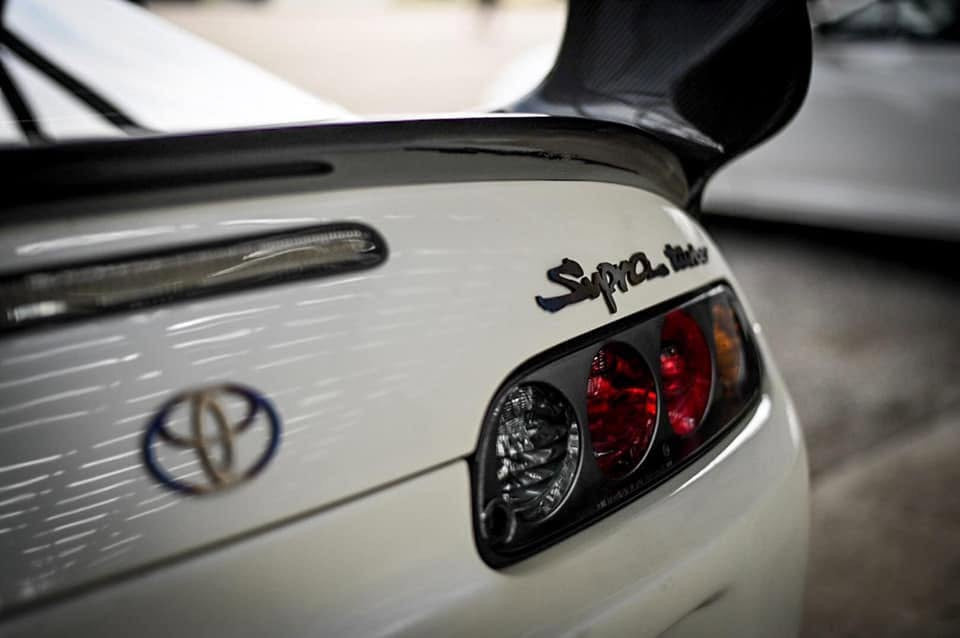

MK4 Supra (JZA80) History: The A80 That Changed Everything
Share
The JZA80 Toyota Supra isn't just a car — it's the car that rewrote the rules on what a street-legal Japanese sports car could be. Launched in 1993 and built until 2002, the MK4 Supra became the benchmark for turbocharged Japanese performance. Two decades later, it's still the first thing enthusiasts think of when someone says "2JZ."
This is the complete history of the A80: where it came from, what made it special, and why J-Spec Garage built a parts catalog around it.
From MK3 to MK4: Why Toyota Rethought Everything
The MK3 Supra (A70, 1986–1992) was a grand tourer — fast, comfortable, and heavy. Toyota's engineers knew the MK4 needed to be something different. The brief was simple: build a proper sports car that could compete with the Porsche 911 and the Ferrari 348 on the world stage.
The result was the A80 chassis — shorter, lighter, and purpose-built for performance. Toyota's flagship sports car would now be defined by one thing above all else: the 2JZ-GTE.
The 2JZ-GTE: Why the Engine Made the Car
The inline-six 2JZ-GTE displaced 3.0 liters and came from the factory with a sequential twin-turbo setup — two CT12B ceramic turbochargers that came on boost in staged sequence to eliminate lag. Output was rated at 280 hp from the factory (the Japanese gentlemen's agreement), but real-world dyno figures routinely showed 320–330 hp at the crank.
What made the 2JZ-GTE legendary wasn't the factory output — it was the block. Toyota over-engineered the cast iron block and forged steel crankshaft to a degree that wasn't necessary for 280 hp. The result: a bottom end that routinely withstands 700–800 hp on stock internals with supporting modifications. At 1,000 hp and beyond, a built bottom end with aftermarket rods and pistons handles the load without drama.
The engine's architecture — closed-deck iron block, undersquare bore/stroke ratio, robust head bolting pattern — combined to create the most tunable platform in JDM history. That's not nostalgia talking. It's physics.
Browse the complete 2JZ / JZ parts collection at J-Spec Garage for turbos, engine internals, fuel systems, and everything else the 2JZ needs to make power.
Production Timeline and Key Variants
The JZA80 was sold from 1993 to 2002 across several distinct markets with key differences builders need to know.
Japan (1993–2002): The full run. Japanese-market Supras came with either the naturally aspirated 2JZ-GE or the turbocharged 2JZ-GTE, both in RHD configuration. Factory Aero package (twinturbo trim) came standard with the Torsen LSD, Brembo four-piston brakes, and the six-speed Getrag V160 gearbox — the strongest OEM manual transmission Toyota ever put in a production car.
North America (1993–1998): US-spec Supras came as targa or coupe body styles in both NA and TT trim. The North American TT Supra was rated at 320 hp — Toyota didn't follow the 280 hp agreement in the US. Production ended for North America in 1998, making clean US-spec examples increasingly rare.
Europe (1993–1996): European-spec cars broadly matched US spec. Shorter production run due to lower sales volume.
RHD and LHD availability: A key distinction for builders sourcing parts. RHD Supras (JDM imports and Australian spec) require different harnesses, dashboards, and some suspension geometry adjustments for LHD conversion. J-Spec's catalog covers both configurations.
The Getrag V160: The Gearbox That Built a Legend
No discussion of JZA80 history is complete without the Getrag V160 six-speed. This German-engineered transmission was built to handle the 2JZ's torque and then some. With proper maintenance, V160s handle 700+ hp builds. The short-throw feel, precise gating, and near-indestructible reputation made it the envy of every 1990s enthusiast who'd ever suffered through a stock RX-7 five-speed.
Automatic-equipped Supras used the A340E four-speed, which while capable, is far less desirable for performance builds. Manual cars command a significant premium in the used market for good reason.
The MK4 Supra in Competition
The A80's motorsport record is extensive. In JGTC (the predecessor to Super GT), the Supra dominated from 1994 through the early 2000s — Toyota factory teams ran heavily developed versions of the 2JZ platform in GT500 class competition. In drag racing, the Supra became the benchmark for top-fuel-adjacent street builds: 7-second quarter miles on the street have been documented on built 2JZ platforms.
In the US, the Supra's pop-culture moment came in 2001 with The Fast and the Furious — a film that introduced a generation of enthusiasts to what an orange MK4 with a nitrous-huffing 2JZ could do to a Ferrari. Culturally impactful? Absolutely. Technically accurate? Mostly not. But the exposure drove demand for 2JZ parts that still hasn't fully subsided.
Best Modifications for the MK4 Supra
The JZA80's modification hierarchy is well-established. Here's what actually moves the needle:
Single Turbo Conversion: The factory sequential twin setup is complex and has failure modes after 30 years. Most serious builders replace it with a single large-frame turbo — a 67mm, 76mm, or 83mm unit depending on power goal. Single turbo kits for the 2JZ include manifold, turbo, and downpipe. Shop Supra turbo kits at J-Spec Garage.
Fuel System: Factory injectors flow 550cc — adequate to around 450 hp. Above that, you're into upgraded injector territory. 1,000cc to 2,200cc injectors, an upgraded fuel rail, and a high-flow fuel pump are the standard recipe for 500–1,000 hp builds.
Engine Management: Factory ECU is capable to a point. For serious builds — particularly single turbo conversions — a standalone ECU (Haltech, ECUMaster, or similar) or a piggyback tune is required. J-Spec stocks both options.
Internals: Stock bottom end handles 700–800 hp reliably with proper tune and cooling. Going above that requires forged pistons, upgraded rods, and ARP head studs. Brian Crower 2JZ engine components are among the most widely trusted in the community for this work.
Cooling: The factory radiator becomes a limiting factor at sustained high-power use. An aluminum race radiator — PHR and others make Supra-specific options — is standard equipment on any serious build.
JZA80 Chassis Numbers and Identification
Key chassis codes to know when sourcing parts or verifying a build:
- JZA80: The chassis designation covering all MK4 Supras (both 2JZ-GTE and 2JZ-GE)
- 2JZ-GTE: Twin-turbo engine — the one builders want
- 2JZ-GE: Naturally aspirated — shares the block and head but different intake, cams, and no turbos
- NA-T swap: Fitting 2JZ-GTE internals and turbo system to a naturally aspirated 2JZ-GE car — a common route for buying a cheaper NA car and converting it
When sourcing parts, always verify whether your car is 2JZ-GTE or 2JZ-GE, and whether it's RHD or LHD. Some components are interchangeable; many are not.
FAQ
How much does a clean MK4 Supra cost in 2025?
Prices have climbed significantly since 2020. Clean targa TT manual examples in the US range from $60,000 to well over $100,000 depending on condition and mileage. JDM imports in RHD vary by spec and title status. The floor on any legitimate MK4 Supra deal is now well above $40,000.
Is the MK4 Supra really reliable?
The 2JZ-GTE is extremely reliable when properly maintained. Known weak points include the twin-turbo system (aging seals and solenoids after 25+ years), the VVTI actuator on later engines, and rubber coolant lines that harden with age. A properly sorted A80 with modern fluids and addressed deferred maintenance is a dependable platform.
What's the difference between a Supra and a 2JZ?
Technically, the "2JZ" refers to the engine family, not the car. The 2JZ-GTE was also used in the Toyota Aristo (Lexus GS300 internationally) and the JZX100 Chaser. But in enthusiast culture, "2JZ" and "Supra" are nearly synonymous — the JZA80 is the car that made the engine famous.
Can you daily drive a built MK4 Supra?
Yes, and many people do. The A80's factory build quality is excellent. A well-built example with a single turbo, standalone ECU tune, and sorted cooling system can be a daily driver. It's heavier than modern sports cars (about 1,560 kg / 3,439 lbs) but rides well on proper suspension.
Where do I find parts for the MK4 Supra?
J-Spec Garage stocks one of the most comprehensive 2JZ parts catalogs available — turbos, fuel systems, engine internals, cooling, and more. Explore the full JZ collection or Toyota Supra forced induction parts to start building your list.
The A80's Legacy
The MK4 Supra was produced for fewer than 10 years and in relatively small numbers — Toyota sold fewer than 12,000 in the US across the entire 1993–1998 run. Yet its influence on JDM culture, drag racing, and the global performance parts industry is impossible to overstate.
The 2JZ-GTE platform generates more aftermarket support today than it did when the car was new. That's not something that happens by accident. It happens when an engine is so fundamentally well-engineered that no one can find a better starting point 30 years later.
At J-Spec Garage, the A80 Supra is what a significant portion of our catalog was built around. Shop the complete 2JZ parts collection and build yours the right way.